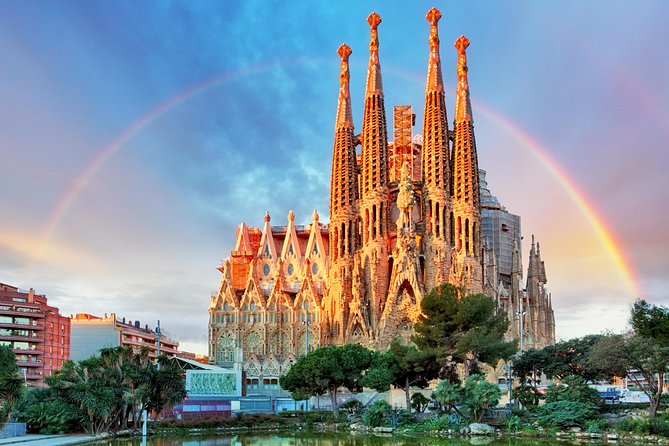
011882–1883
A Gothic starting point
Villar began the crypt with pointed arches and a conventional Gothic Revival plan. Gaudí inherited foundations, not an empty site.
LegacyThe crypt preserves the project’s earliest architectural language.
Sagrada Familia history begins in 1882, with a Catholic church funded by donations. Gaudí transformed its design, but later generations built much of what stands today. Understanding that shared authorship helps explain the basilica’s contrasting forms.
Bookseller Josep Maria Bocabella promoted the project through the Association of Devotees of Saint Joseph.
Donations bought land in Barcelona’s expanding Eixample. The aim was an expiatory church: worship and gifts offered in atonement for sin, rather than a royal commission.
Francisco de Paula del Villar designed the original neo-Gothic church. Gaudí took over in 1883, after construction had begun. Calling everything here “Gaudí’s work” also overlooks the architects and artists who continued after his death.
Construction, destruction and reconstruction all shaped what survives.
Villar began the crypt with pointed arches and a conventional Gothic Revival plan. Gaudí inherited foundations, not an empty site.
Gaudí developed a far larger church and prioritised the Nativity façade. Its first bell tower was completed in 1925.
After Gaudí’s death, Domènec Sugrañes directed construction. His team completed the remaining Nativity bell towers using the inherited designs.
During the Spanish Civil War, attackers burned the crypt and workshop. Drawings were lost and plaster models smashed.
Francesc de Paula Quintana helped restore the crypt and reconstruct damaged models. Surviving fragments supported renewed construction.
Construction began on the Passion façade. Josep Maria Subirachs joined the project in 1986, giving its sculpture a distinct modern language.
With the nave covered, Pope Benedict XVI dedicated the church and proclaimed it a minor basilica. Worship did not require the entire project’s completion.
Donation funding made construction dependent on available money. The long building period began well before modern tourism.
Gaudí tested forms in plaster. Losing those models meant losing practical instructions, not merely exhibition objects.
The planned eighteen towers represent Jesus, Mary, the four Evangelists and twelve Apostles: a religious hierarchy expressed through architecture.
Gaudí retained a cross-shaped plan while rethinking how a large church could stand.
Inclined, branching columns direct loads towards the ground. Different stones, including granite and porphyry, serve different structural demands.
The basilica joins Catholic devotion with Barcelona’s Modernisme. UNESCO recognises Gaudí’s creative contribution through specific historic elements, not the whole later building.
The crypt survives with repairs after the fire. The Nativity façade combines Gaudí-era work with later completion and conservation.
Joan Vila-Grau’s stained glass is a modern contribution, not glass installed under Gaudí.
Authorship matters as much as appearance.
They recall the Gothic Revival starting point beneath Gaudí’s later structural experiments.
Their unified appearance hides a completion history spanning Gaudí and Sugrañes.
Their style records a later artist’s contribution, rather than a change in Gaudí’s carving technique.
Reconstruction helped recover design knowledge after the workshop’s destruction.
The material changes express structural needs, not just decorative variety.
Vila-Grau’s colours show how later artists helped shape the interior visitors know today.
Look for the difference between inherited design, surviving stone and later interpretation. Then use our independent visitor guide to plan your visit.